Issue 02 · Long Read
Why did the cloud land in a Devon field?

The proposed Devon Data Campus would put one of Europe’s largest AI data centres beside Great Torrington. The obvious question isn’t whether Britain needs data centres. It’s why this one needs to be here.
My son might have gone to school in Great Torrington. We live down the road. So when a company proposes one of Europe's largest AI data centres on land between the town, Huntshaw and Weare Giffard, I do not experience it first as an abstract argument about Britain's digital future. I picture a school run, a skyline, and the place where we had imagined him growing up.
That is a reason to investigate carefully, rather than to claim that a computer building will poison him. It is also a reason to ask a question which deserves a better answer than “there is a substation nearby”:
Why here?
Xlinks calls its proposal the Devon Data Campus. Its Valeon data centre is advertised as providing up to 1.5 gigawatts of AI-optimised compute capacity, with a 1.8 gigawatt battery energy storage system proposed alongside it.
Those figures describe different things: computing capacity and the battery's power rating. A battery is not a source of continuous electricity. Nor should 1.5 GW of advertised compute be mistaken, without a detailed design, for an independently verified figure for the site's eventual grid import.
The company proposes separate planning applications, with outline permission sought for the data centre and full permission for the battery. Its current site says the applications will go to Torridge District Council in the new year; its public events have been postponed and its consultation extended.
Nothing on that timetable amounts to planning permission.
How, then, did a proposition this large arrive beside Torrington?
Start with the wire
Xlinks' earlier ambition was to deliver Moroccan wind and solar power to Britain through a roughly 4,000 km undersea cable.
The proposed British connection was Alverdiscott.
Its environmental statement recorded a firm offer at that time for two 1.8 GW connections into the substation, and explained that the choice of grid connection shaped the areas subsequently examined for landfall, converter stations and cables.
The government declined to offer the power project a Contract for Difference in June 2025; Devon County Council now records that project's development consent application as withdrawn. Xlinks still describes connection agreements near Alverdiscott on its website.
The original site-selection paperwork lets us follow the choice further back.
Xlinks applied for the Morocco project's grid connection in May 2020. The grid operator's appraisal examined five existing substations: Alverdiscott, Pembroke, Seabank, Indian Queens and Exeter.
The search area was shaped by a cable rounding the Iberian Peninsula.
Seabank meant a longer offshore route and awkward construction access; Indian Queens posed landing, cable-route and nearby environmental constraints; Exeter raised problems with a longer trench, other cables and fitting two connections.
An early offer even split the project's two 1.8 GW connections between Pembroke and Alverdiscott. Further work found a second Pembroke connection difficult, and the eventual preference was for both at Alverdiscott: one onshore cable route, space for grid works and converter stations, and what the appraisal judged fewer conflicts.
An economic comparison also favoured the South West option for that power-import project.
After fixing the grid point, Xlinks searched within 2 km for its converter stations, partly to limit the length, losses and construction corridor of connecting cables.
Its papers name the old Webbery showground and Huntshaw as candidate sites. Torridge initially raised concerns about the elevated Webbery location; consultation brought strong objections to Huntshaw's proximity to homes, visual impact, steep land and access works; Xlinks returned to Webbery with design changes.
These were choices for the old converter stations, not a published comparison of national sites for Valeon.
The distinction matters because it shows how decisions accumulate: choose the connection, then narrow the land search around it.
The new scheme reverses the direction of the story.
Instead of bringing a vast quantity of electricity into the grid here, Xlinks wants to build a vast potential user of electricity beside it.
That is my inference from the project's chronology, not evidence that the old import contract automatically grants the data centre a 1.5 GW demand connection.
The precise connection rights, dates, reinforcement requirements and division of grid capacity between Valeon and the battery need to be published for the new proposals. They are central to the case for this location.
Here is the question beneath “why here?”:
Which parts of a study designed to land Moroccan electricity still make sense for a facility consuming electricity in Britain?
A longer submarine cable is no longer a reason to reject Seabank.
The need to put two converter stations within 2 km of an HVDC connection is no longer a reason to reject an industrial campus elsewhere.
Alverdiscott may still win a fresh comparison, but the old comparison cannot do that work for the new project.
Xlinks now says brownfield options were part of its search.
Its published answer names no sites, gives no scores and supplies no cost comparison.
Publish the search, then.
Xlinks offers other reasons: mild weather, proximity to planned renewables, a reliable grid connection, distance from homes, and landscape screening. It forecasts hundreds of permanent jobs and substantial economic output.
Those are claims a planning authority must examine; they are not reasons to wave the company away.
Yet there is a difference between a location being convenient for a project assembled around a particular substation and that location being the best place for Britain to put a power-station-scale computing industry.
Its own FAQ makes the tension plain.
It says it holds an option over up to 850 acres, while current layouts would use around a third of the optioned area: potentially around 280 acres if the full option were taken up, before anyone calls the remaining land a public benefit.
It describes around 1,720 containerised battery units.
It says the campus would be powered from the national grid, with no current plan for the Morocco link.
It promises self-sufficient cooling-water top-ups from rain, no impact on local electricity prices, and no noise beyond its boundary.
Those may be aspirations a design can support.
Without the annual power profile, battery energy capacity in MWh, cooling design and dry-year water balance, baseline sound measurements and network-cost assessment, they are not demonstrated outcomes.
How the rules let it get this far
Britain's planning policy increasingly wants data centres.
The August 2026 National Planning Policy Framework explicitly tells planners to provide for them and to recognise the locational importance of infrastructure such as adequate grid connections.
Government policy is also trying to speed up large AI developments.
Data centres were designated critical national infrastructure in 2024, a security and resilience classification.
That is distinct from receiving planning permission or being automatically designated a nationally significant infrastructure project. Some data centres can be directed into the latter consenting route, but Xlinks currently says it intends to apply to Torridge for these two proposals.
The same planning framework favours the effective reuse of previously developed land and protects living conditions, tranquillity, dark landscapes and nature. It gives substantial weight to benefits from remediating derelict land.
What it does not provide is a simple nationwide instruction that a private data-centre applicant must rule out Eggborough, Didcot and every other former power station before submitting an application near Torrington.
Guidance on environmental impact assessment is more limited than the slogan “prove there is no alternative”: the regulations do not require an applicant to invent and examine alternatives it has not studied; where it has studied reasonable alternatives, it must explain them in its environmental statement.
There is a local procedural answer too.
According to a published account quoting Torridge District Council, officers gave Xlinks initial pre-application advice on the data centre in April 2025 and on the battery in November 2025.
The council said this advice is informal, does not bind a future decision, and is not a stage at which it conducts public consultation.
Xlinks' own consultation is happening now; Torridge's statutory consultation would follow formal applications.
That distinction explains both why discussions could have gone on for more than a year and why residents can reasonably feel they heard late about a scheme that officers had already seen.
That is the seam this project exposes.
Grid policy can make one place commercially irresistible before a public debate about the best national location has happened.
Then the planning system assesses the scheme placed before it, balancing the economic case against its effects.
A developer can consult, commission surveys, talk to a council and secure land interests long before a councillor votes on permission.
“How was this allowed to get so far?” has a prosaic answer: because proposing a development is not approving it, and the siting test many of us assume exists may not exist in the form we imagine.
The scale of grid demand makes this more than a local curiosity.
In July, Ofgem reported that contracted demand offers had risen from 41 GW to 125 GW between November 2024 and June 2025, with data-centre projects accounting for at least 80 GW of demand in the queue.
Ofgem is consulting on fees and milestones to prevent speculative schemes from occupying scarce connection capacity.
Those queue numbers are applications and offers, not 80 GW of built data centres.
They do, however, show why a grid connection has become a powerful factor in land choice.
Put the serious alternative on the table
Former power stations are not an imaginary solution.
Microsoft has proposed data centres on part of the former Eggborough Power Station and at Skelton Grange in Leeds.
Amazon is pursuing a campus on part of the former Didcot A site; an Environment Agency application describes approximately 23 hectares formerly used for coal storage and cooling towers.
Ratcliffe-on-Soar has outline permission for redevelopment that includes a data-centre use.
At the former Cottam station, a consortium is pursuing a data-centre campus alongside the much more speculative ambition of small nuclear reactors.
Drax is preparing an initial data-centre proposal below 100 MW using a former coal-generation grid connection, while exploring a much larger long-term scheme.
The list need not stop at power stations.
At Wilton International on Teesside, an April 2026 application describes an AI-capable data centre on previously industrial land within a roughly 780-hectare chemicals complex. Roads, hardstanding and electricity infrastructure already exist, though the application itself still has environmental questions to resolve.
The Cambois development near Blyth occupies a former power-station site; the wider North East AI Growth Zone has ambitions for 1.1 GW over six years.
In South Wales, a data-centre campus is being advanced at the former Ford Bridgend engine plant.
These are places where industrial use, large electrical systems or public planning for compute already form part of the story.
The choice is not necessarily one 1.5 GW enclosure or nothing.
A developer could test several smaller phases across industrial energy hubs, though splitting a tightly coupled AI training cluster could impose real networking costs and operational limits.
A national siting appraisal would price those trade-offs, alongside construction roads, land assembly, new transmission equipment, cooling, water supply, remediation, and the loss of productive rural land.
It would distinguish the developer's bill from costs borne by the grid, nearby residents and the environment.
None of these is a vacant, consented, immediately interchangeable 1.5 GW plug.
Ratcliffe still requires demolition; Drax's first phase is smaller; many sites have their own committed developers; grids and fibres have capacities and costs, not just dots on a map.
Industrial land can also be close to homes or sensitive habitats.
Nor can I honestly say one of these sites is already cheaper: there is no published, comparable costed design for Valeon at each location.
Drax argues that reusing its infrastructure can avoid expensive and disruptive construction elsewhere; that is a credible cost mechanism, not a price comparison for Devon.
The fair proposition is narrower and stronger:
The UK already has a real class of energy-intensive, previously developed sites. Why is a rural site the preferred answer for this particular scheme, on an independently testable comparison of grid readiness, land take, water, heat, cost, jobs and environmental harm?
The more exotic alternatives are worth studying, but should not become a distraction.
Microsoft's sealed underwater data-centre experiment ran off Orkney for two years and reported a much lower server failure rate than its land-based control.
It demonstrated a technology, not a route to installing 1.5 GW under the Channel next year.
Undersea installations still need power, fibre, seabed works, maintenance and a place for their heat to go.
An industrial coastal site near offshore energy may be more plausible today than sinking thousands of tonnes of computers in the sea.
Ask for the engineering, then make a judgement
The strongest local objections will depend on what Xlinks actually designs.
Its website calls completed data centres and batteries “quiet neighbours” and says environmental assessments will inform mitigation.
That is an assertion to test with baseline measurements, modelling, operating limits and enforceable conditions, especially for night-time cooling plant, transformers, tonal noise, construction traffic and the battery system.
Ask for the water balance in a dry summer, including maximum abstraction and discharge.
Ask where the rejected heat goes.
Ask how much electricity the full build would draw at peak and across a year, what supplies it in a windless winter week, and which network upgrades are required.
And ask about backup generation.
Diesel exhaust is classified as carcinogenic to humans, and large data-centre generator arrays can require environmental permits.
That establishes a legitimate subject for scrutiny; it does not establish that this proposal uses diesel generators, what their emissions would be, or that local people would face a harmful exposure.
The specifications, hours of testing, stack design and air-quality assessment must come first.
Likewise, ancient woodland is strongly protected under national policy, but the earlier Morocco project's environmental documents must not be treated as a map of damage from the newly proposed campus.
Demand an accurate habitat map for this scheme.
I would ask Torridge to assess the data centre and battery both individually and together, including the cables, roads and any associated grid works.
National environmental-assessment guidance expressly warns against treating an integral part of a larger development in isolation.
The company's statement that each scheme could operate independently does not remove the need to examine their combined effects.
Perhaps a rigorous assessment will show that this location can accommodate the project with acceptable impacts.
If so, let us see the evidence and the conditions.
Perhaps it will show that the promised jobs, available power and engineering advantages outweigh the harm.
Let us see the assumptions behind those numbers too.
But a convenient grid node is the beginning of a siting argument, not its conclusion.
The previous project evaluated South Wales and the South West for a cable from Morocco.
The new one would occupy hundreds of acres for a computer campus.
Its developer says it considered brownfield sites, but asks the public to accept a vague dismissal of them.
An environmental case based on an unpublished comparison is not a comparison the public can test.
That is the absurdity here, before a shovel touches a field.
People who live near Torrington should not have to choose between accepting a huge new industrial landscape on trust and being dismissed as opponents of progress.
We are entitled to know why this place beats the alternatives, what exactly would be built, and who carries the costs after the ribbon is cut.
The cloud has a location. Somebody should have to defend it.
What to do before the decision is made
Ask Xlinks to publish its brownfield longlist and scoring, the current grid import and export agreements, a like-for-like comparison with at least three industrial or former power-station sites, and the battery's MWh capacity.
Questions about the data centre can be sent to [email protected] and questions about the battery to [email protected]. Ask for a written answer that can be shared publicly.
Ask Sir Geoffrey Cox, MP for Torridge and Tavistock, to seek the connection and alternative-site evidence from Xlinks, NESO and the relevant ministers, and to say whether a project this size deserves a national siting comparison. Constituents can contact his parliamentary office at [email protected].
And ask Torridge's planning team how the two applications and their associated grid works will be assessed cumulatively, when the environmental documents will be available, and how to register for notice of both applications.
The company's current consultation is not the council's formal application consultation.
When applications are submitted, inspect the actual drawings and submit a fresh, evidence-led representation against each relevant application.
Sources and reporting notes
Xlinks, Devon Data Campus consultation and project overview.
Xlinks' Morocco project environmental statement, non-technical summary, section 5.2.
Xlinks, Morocco project update; Devon County Council, withdrawn DCO status.
National Planning Policy Framework, August 2026, especially E1/E2, L2, P3 and N6.
Government, data centres as critical national infrastructure; section 35 data-centre direction example.
Government planning practice guidance, environmental impact assessment, especially paragraphs 025 and 041 and guidance on integral development.
Ofgem, proposed data-centre connection reforms, 29 July 2026.
East Midlands Combined County Authority, Ratcliffe redevelopment.
IARC monograph, diesel-engine exhaust; Environment Agency example of data-centre backup-generation permitting.
Crediton Courier, reporting Torridge's pre-application statement — secondary; verify directly before publication.
Xlinks' November 2024 Planning Statement, Annex 2, section 4.1 and 4.2 (PDF pp. 552–556) — the Morocco power project's site-selection account, not a Valeon appraisal.
Redcar and Cleveland planning portal, Wilton International Planning Statement.
North East Combined Authority, AI Growth Zone; Coal Authority, Cambois former power-station land.
Xlinks, Devon Data Campus FAQ, especially “Why isn't it being built on a brownfield site?”, “How much of the land would actually be built on?” and the power, water, noise and battery answers.
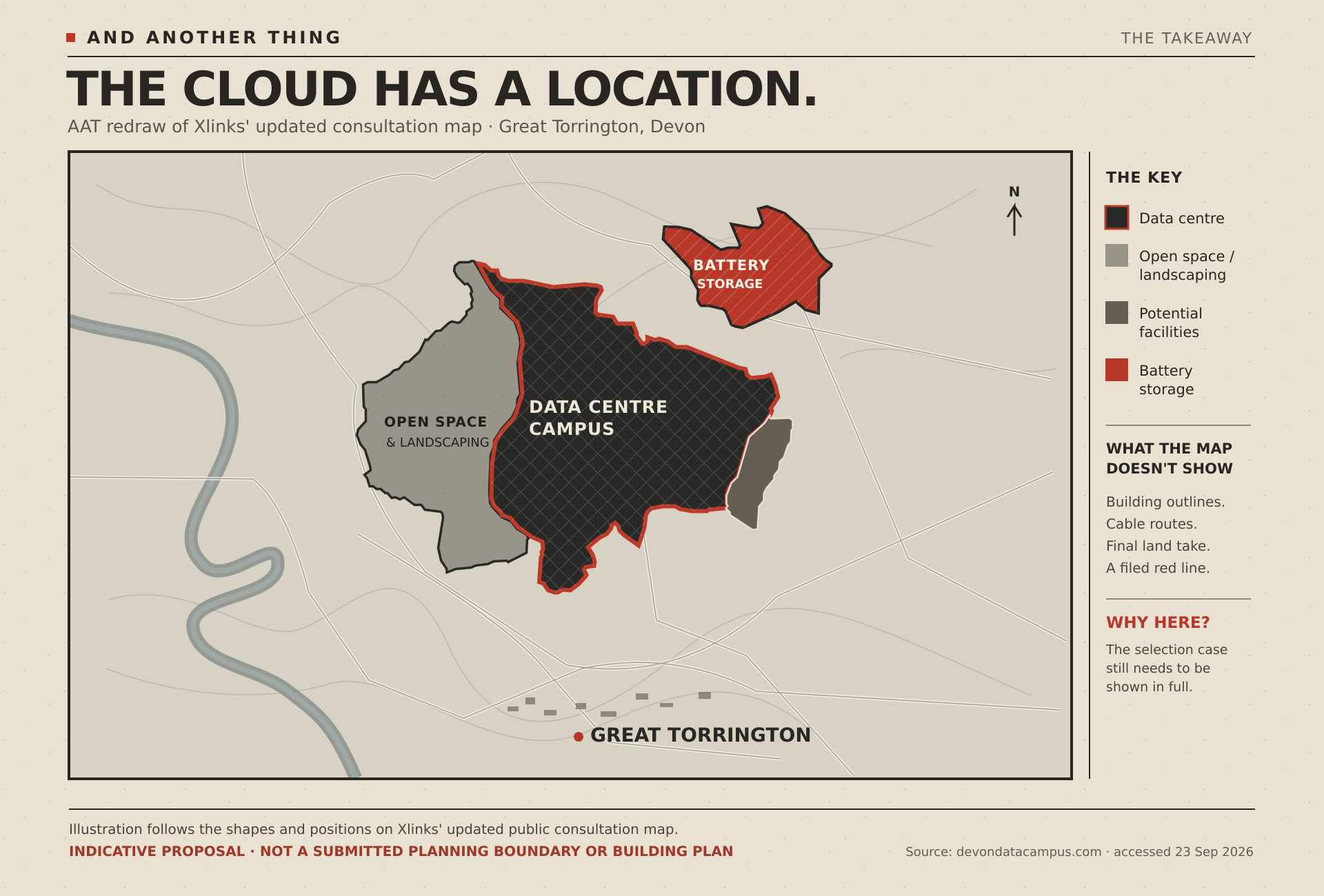
Xlinks, updated Devon Data Campus consultation map — the developer says it corrected an earlier map; these are indicative consultation areas, not submitted red-line plans.
Cllr Cheryl Cottle-Hunkin, public Facebook reel — the platform-generated video-player embed was unavailable in an unauthenticated test; the direct reel remained viewable.
The illustrated map follows the developer’s public consultation map as accessed 23 September 2026. It is indicative, not a submitted planning boundary or building plan.