Issue 03 · THE LONG READ · 6 October 2026
AI or Bust
Nobody wants to drown in slop. The useful machine deserves better than an internet full of competent nothing.
There is now an artificial intelligence in the fridge.
This is not a metaphor. Samsung has put Google Gemini into a refrigerator so that it can identify a broader range of fresh produce and packaged goods, tell you what is inside and, if sufficiently encouraged, make suggestions about dinner. It cannot see the things in the door bins or the freezer, which feels like quite a serious blind spot in a machine whose main qualification is being a fridge. The useful question is whether any of this makes feeding a household easier. A demonstration is not dinner.
There is AI in household appliances, office software and customer-service systems. There are AI meeting assistants attending meetings that should have been emails and summarising them for people who should not have been invited. There are AI agents being designed to supervise other AI agents, presumably because even a machine needs a line manager who contributes very little but asks for a status update by Friday.
We have taken a genuinely useful family of technologies and turned it into parsley. It is sprinkled on everything, whether the meal needs it or not.
Somewhere along the way, using the tool became joining the movement. Organisations are encouraged to choose AI or risk being left behind, as though every useful technology required a loyalty oath. Meanwhile, the reader has a smaller ambition: please stop filling the day with things that barely needed to be written.
We are not going to smash the servers or return to the quill. Statistical models have a place in research, accessibility and the thousand small administrative jobs that human beings hate and machines can do without needing a little cry in the car afterwards. AI is obviously useful. We use it. You probably use it. If you do not use it, you are almost certainly using something that uses it without bothering to tell you.
What needs to die is AI as an answer looking for a question. AI as a badge on the box. AI as the compulsory final slide in every corporate strategy. AI as the grand explanation for redundancies that were going to happen anyway. AI as the instruction to generate more material simply because material is now cheap to generate. AI as a strange managerial faith in which the appearance of activity counts as progress and nobody is required to show what got better.
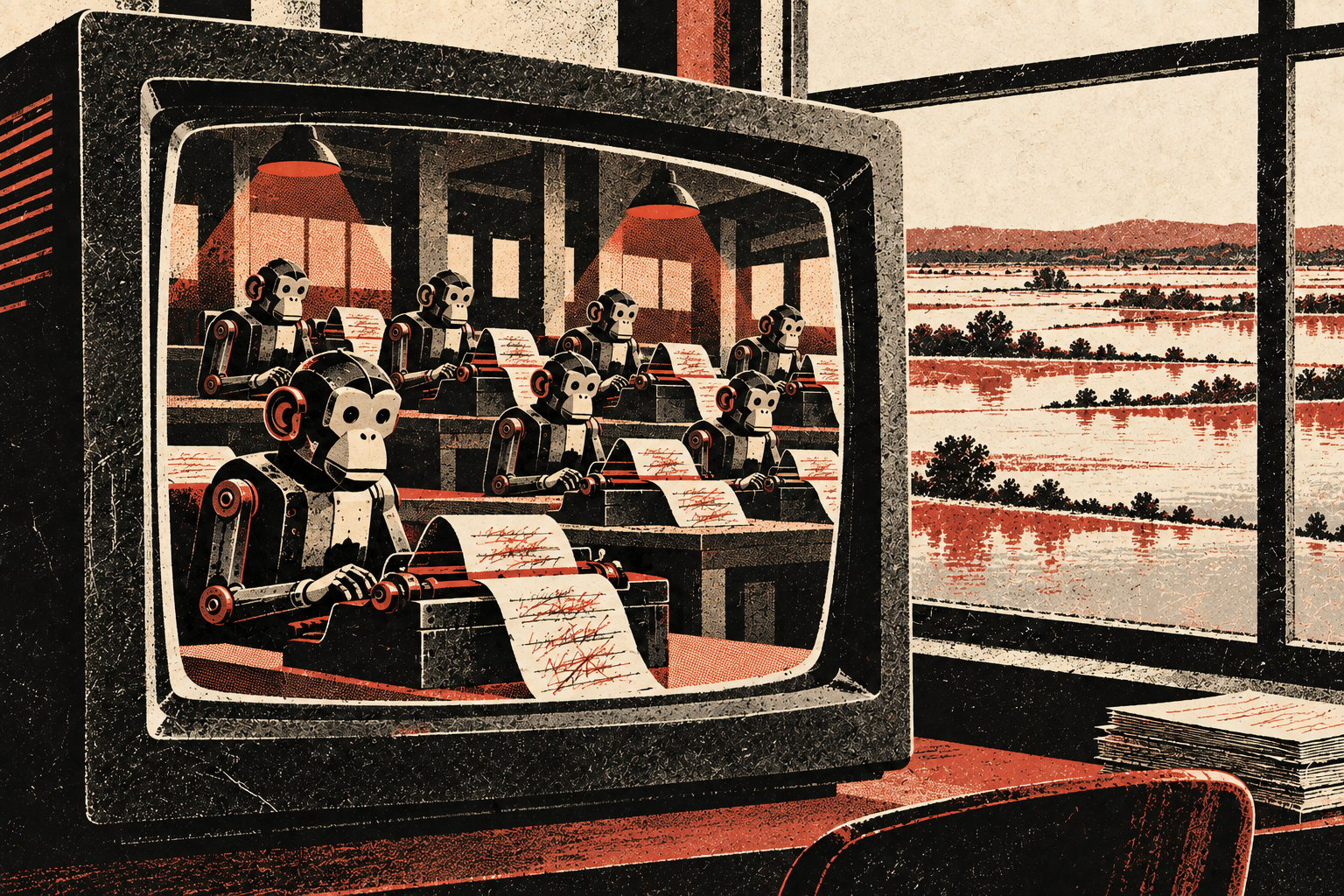
The monkeys have not taken over the typewriters. We have simply bought more typewriters, filled a warehouse with monkeys and congratulated ourselves on the volume of typing.
We have confused availability with usefulness
The awkward thing about this boom is that the technology works. If it did nothing, the argument would be easy. It can summarise a long report, compare two documents, clean a transcript, help a programmer locate a fault, translate a rough explanation into plain English and give someone staring at an empty page a place to begin. For a writer who already understands the subject, those can be useful jobs to hand over.
That last word matters: suitable.
The work has a boundary. The user knows what good looks like. The source material exists. Errors can be found. A competent person remains in charge. Under those conditions, the machine is not replacing thought. It is removing drag.
The trouble starts when removing drag becomes the whole purpose of an organisation. Friction is not always waste. Sometimes friction is the interview in which an expert stops, changes their mind and finally explains what they really mean. Sometimes it is the editor asking where a number came from. Sometimes it is the awkward workshop where two departments discover that their versions of the plan are incompatible. Sometimes it is the half-hour in which a writer stares at three contradictory documents and realises that the contradiction is the story.
AI can make the production of an answer faster. It cannot decide whether the organisation has asked the right question, unless somebody has first done the difficult work of telling it what “right” means. Yet companies keep buying systems as though intelligence were a powder that could be tipped into the existing pipes. Same processes, same incentives, same data, same management, now with AI. The fridge is still a fridge. It just has Gemini in it.
The useful measure is the completed job, including the checking, correction and work handed to other people. A system that produces a draft quickly may still leave the organisation with a slow and expensive answer. Buying a tool and changing a business are different jobs.
AI can improve individual tasks while making no visible difference to the business that contains them. A writer produces a draft in ten minutes instead of an hour; four additional people review it because nobody trusts it; the legal team asks where the claims came from; the expert rewrites the technical section; the customer notices that it sounds like everything else. A saving has occurred somewhere. Nobody can quite find it.
The infinite beige document
Writing was an obvious early target because words are expensive and management has always suspected there might be a cheaper way of obtaining them.
Now there is. The internet is filling with prose that is competent in precisely the way an airport hotel is comfortable. Everything is present. Nothing is wrong. You will not remember any of it once you leave.
Pew Research Center found signs of AI authorship in more than a third of sampled pages with publication dates after ChatGPT appeared. That is dated content in its sample, not a census of the whole internet. Detection is imperfect, too. The finding is a warning about scale, rather than a licence to accuse every person who writes a tidy paragraph of being a robot.
The problem is not that a machine cannot form a sentence. It can form millions of perfectly serviceable sentences before breakfast. The problem is that communication is not a sentence-forming contest. It is a transfer of meaning between people who have reasons to care.
Most corporate language was already in trouble before AI arrived. It had been trained by committee to avoid risk, personality, specificity and anything else that might cause a reader to remain conscious. Artificial intelligence did not invent “market-leading”, “customer-centric”, “seamless” or “innovative”. It merely industrialised them. Give a model enough old bid answers, product pages, HR announcements and thought-leadership articles and it will reproduce the average of all of them beautifully.
This is not plagiarism in the old-fashioned sense of somebody pinching your paragraph. It is something foggier and perhaps more consequential: the compression of millions of decisions into a house style nobody chose. A separate study using Internet Archive material found an association between AI-generated text and reduced semantic diversity. It did not establish every feared consequence, including reduced factual accuracy or stylistic diversity. Our narrower concern is editorial: accept the first plausible answer often enough and the business begins to lose its own point of view.
That creates a peculiar market. Writing has never been more plentiful and recognisable writing has never been more valuable. Anybody can produce 1,200 words about leadership. Far fewer people can spend an hour with a nervous engineer, understand the thing she has built, find the part that matters and explain it in language that still sounds like her. Anybody can generate ten benefits. Far fewer can tell which benefit changes the buyer’s decision, what evidence would make it believable and which confident claim will collapse when the contract starts on Monday.
The first draft is becoming free. Judgement is not.
The cost is outside the window
The machines in our cover illustration are indoors, typing furiously. The consequence is outside, where the water is rising so gently that nobody thinks to stop.
There is a danger in talking about the environmental cost of AI as though every prompt personally murders a polar bear. The numbers are more complicated than the memes, the footprint varies by model and location, and data centres do useful things besides generate pictures of famous politicians as muscular babies. Efficiency is improving. Renewables will meet a significant share of the additional electricity demand. AI may itself help manage grids, design materials and reduce waste.
Fine. Now look at the scale.
The International Energy Agency’s 2026 update puts data-centre electricity consumption at 485 terawatt-hours in 2025 and projects about 950 by 2030. It reports 17 per cent growth in overall data-centre demand during 2025, and 50 per cent for AI-focused facilities. Those are data-centre figures, not a meter attached solely to chatbots. The projection can change. The physical demand for electricity, infrastructure and decisions about where to put it is already here.
This might be a price worth paying for better drug discovery, more accurate forecasting, safer infrastructure and genuine scientific work. It is harder to defend when the same capacity is being used to make a fridge offer lasagne, replace a functioning customer-service team with a chatbot or generate six hundred variations of an advert nobody wanted in the first place.
The environmental argument is not “stop computing”. It is the same argument we should make about any scarce resource: decide what deserves it.
At present, the market’s answer is “whatever somebody can monetise fastest”. Hence the robots type. The river moves another inch across the field.
Meanwhile, quantum computing is being boring in the corner
Quantum computing has its own sales department, so it would be foolish to appoint it the virtuous alternative. IBM’s roadmap targets a large-scale fault-tolerant machine in 2029. A company target is a company target. It should be assessed against what the machines can actually do, on useful problems, with credible comparisons.
The interesting work includes making quantum calculations reliable enough to use. That is difficult to turn into a funny vertical video. It involves error correction, hardware and patient experiments rather than a machine producing the impression of a finished creative work.
There is no reason to turn one field of computing into the hero of an argument against another. Both deserve the same questions: what problem does this solve, how do we know, what does it cost and who benefits? We mention quantum because it makes the attention economy look a little ridiculous. Research that is hard to demonstrate can be culturally invisible; a chatbot that produces an instantly recognisable imitation is everywhere.
We notice the monkey because the monkey is typing at us.
Let the tool become boring
The best future for AI is not that it becomes more exciting. It is that it becomes plumbing.
We stop putting the initials on everything. We stop pretending a product has been transformed because it can call a model somewhere. We stop rewarding volume and start charging for the costs of producing it. We ask what the system does, what evidence shows it works, what data it used, what it consumes, who remains responsible and whether a simpler tool would do the job.
Writers use it where it helps. Researchers use it where results can be checked. Doctors, engineers and scientists use specialised systems within professional boundaries. Disabled people use it to remove barriers. Small organisations use it to do work they could not otherwise afford. Nobody needs to join a movement. Nobody has to pretend the fridge is clever.
And human beings continue doing the work that only looks inefficient if you have misunderstood it: listening, doubting, choosing, noticing, caring, changing our minds and accepting responsibility for the result.
AI or bust is a splendid instruction if your job is selling AI. For everyone else, there is a less theatrical test. Did the work get better? Did the person reading it gain anything? Did somebody remain responsible for the answer?
If not, stop the typewriters. We have quite enough paper in the water.